
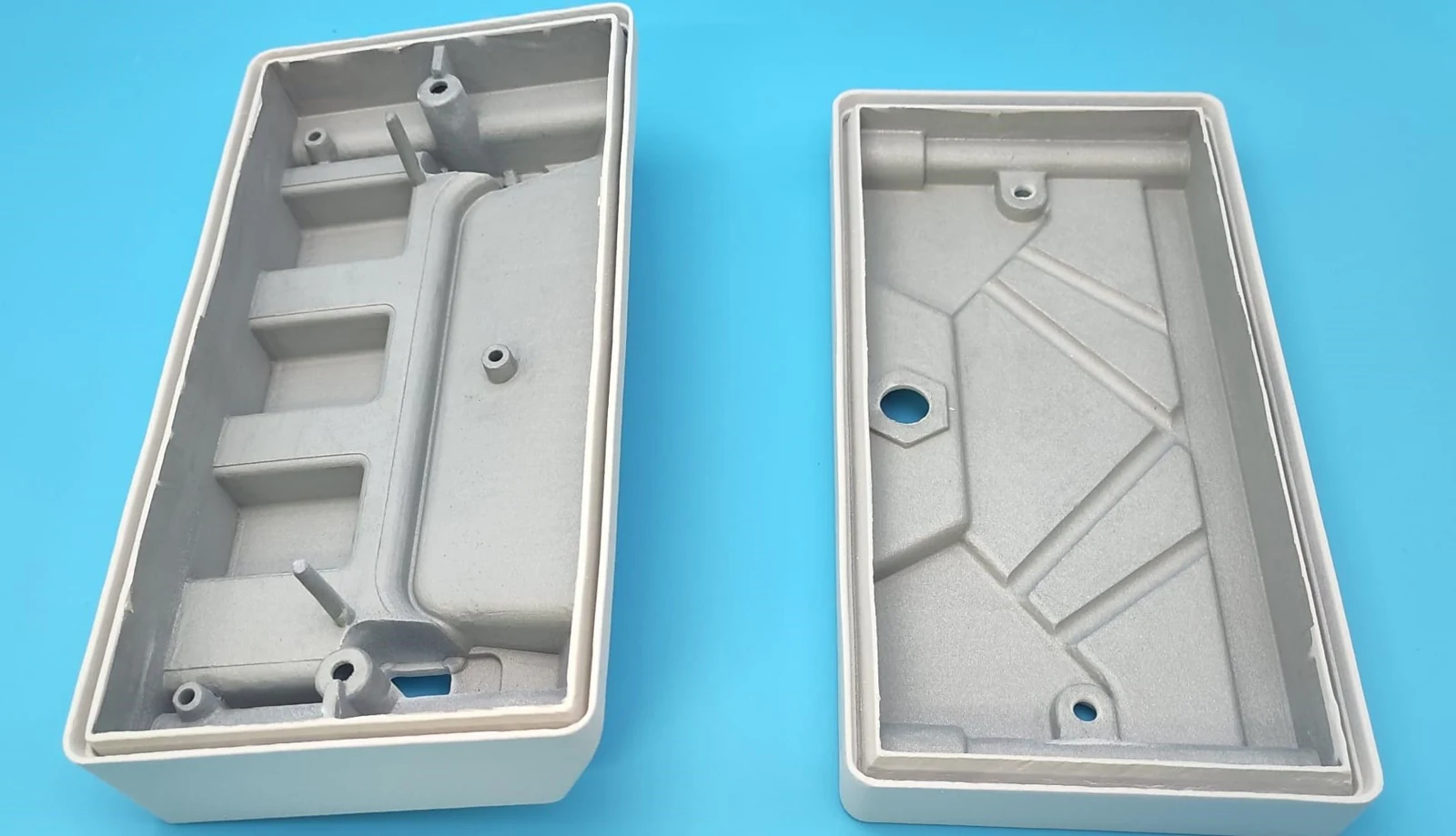
Enclosures & covers
Protect components and integrate interfaces correctly.
Discuss your project ↗What your part needs to do.
Openings, fastenings, sealing surfaces and visible sides are clarified early. Material, quantity and finish requirements determine the choice between additive manufacturing, CNC, sheet metal and casting.
The technologies below may suit your material, geometry, quantity and test objective. We make the selection together with you.
Possible manufacturing methods.
SLA · Stereolithography ↗
Fine details and smooth surfaces for design models and enclosure prototypes.
3D printingSLS · Laser sintering ↗
Durable plastic parts with complex geometry for functional tests and small batches.
3D printingMJF · Multi Jet Fusion ↗
Functional polyamide parts for repeatable small batches and compact assemblies.
CNC machiningCNC milling ↗
Precise enclosures, brackets and parts with specified fits.
Sheet metal fabricationLaser cutting ↗
Precise sheet metal blanks with custom contours and cut-outs.
Sheet metal fabricationSheet metal bending ↗
Brackets, covers and enclosures made from bent sheet metal.
Sheet metal fabricationWelding ↗
Join metal parts into coordinated assemblies.
Sheet metal fabricationWaterjet cutting ↗
Contours and plate blanks without the heat-affected zone of thermal cutting.
Vacuum castingSilicone moulds ↗
Moulds for reproducing small batches of plastic parts.
Vacuum castingPU vacuum casting ↗
Production-like samples with coordinated colour, feel and material properties.
Injection mouldingRapid tooling ↗
A tooling strategy suited to the development stage.
Injection mouldingPlastic injection moulding ↗
Repeatable plastic parts with defined geometry and surface finish.
Your next part starts here.
Send us your CAD data, a drawing or your idea. We will discuss the process, material and specifications with you.